Showing posts with label portable generators. Show all posts

Wednesday, December 31, 2014

Generac Portable Generators

Portable Generators come in all shapes and sizes, but which one's right for you?  The first question you need to ask yourself is what you are using it for.  There are several styles that are intended for particular uses, so you may end up overpaying for under-powering.  The three basic styles are emergency, recreational and professional use. 

Generac portable generators are some of the most popular generators on the market & the most common application is going to be providing backup power to your home during a blackout.  Generac labels these emergency generators under the "GP" series, and are designed for occasional use only.  They are affordable and can pack a punch.  The GP5500 starts at under $700 and features 5500 running watts capable of powering several survival appliances such as your refrigerator, light, sump pump and furnace fan.  You can step up to the Generac GP7500E for a little extra power to power multiple rooms.

Recreational generators are great for tailgating and camping, and are designed to provide clean, quiet power.  They typically have limited power capabilities, usually found in the 800-3000 watt range.  The Generac iX800 features an inverter alternator keeping the noise and weight to a minimum, weighing in at under 28 lbs.  It also has an eco mode that will reduce fuel consumption and noise even further.


Generac professional generators are truly professional grade, engineered specifically with contractors in mind.  The Generac XP series generators, like the Generac XP8000E, are designed to withstand the tough demands of extended job site use, and feature pressurized lubrication systems, less than 5% THD, full panel GFCI protection, and a tough steel tube cradle.
Wednesday, November 26, 2014

Portable Camping & RV Generators

Who needs hotels?  We have the great outdoors.  But who says we can't have a few of the creature comforts of home while we're taking in Mother Nature?  Whether pitching a tent or pulling up in a stylish RV, a generator will let you bring a little bit of civilization with you into the wilderness. 

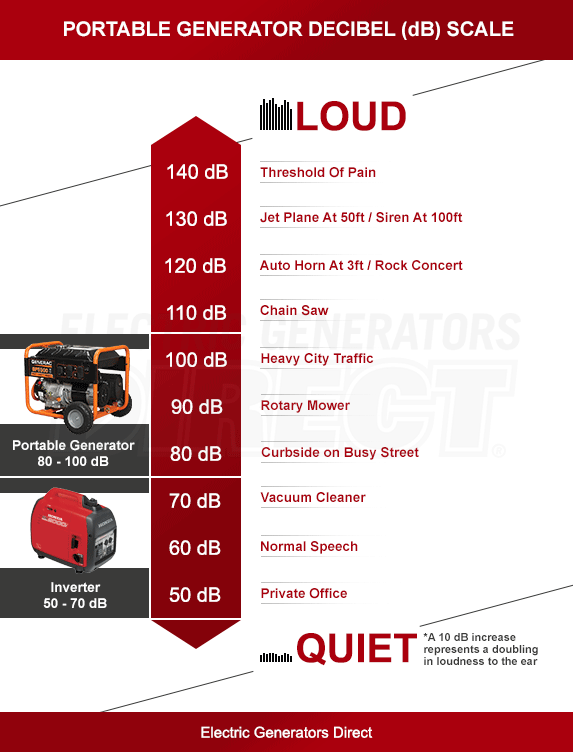
Portable generators are a great source of electricity when off the grid, but if you or your new neighbors value the beauty of nature, you might want to keep that noise to a minimum.

Camping generators are typically much quieter than conventional generators because they feature inverter alternators that generate a very clean AC power supply.  Because of this, they are also much smaller and lighter than their conventional counterparts.  Another important aspect of camping generators is that their engines can run at different speeds depending on the load, which further reduces the noise as well as fuel consumption.  The clean power produced by an inverter is particularly important when it comes to powering sensitive electronics such as laptops.

This step up in technology does come at a price.  A camping generator can run 2-3 times the price of a conventional generator with comparable wattage. However, when you consider all the advantages an inverter camping generator has in a camp setting, you'll understand the price difference.  

A conventional generator like the Generac GP1800 is rated at 1800 watts, weighs over 85 lbs, carries 3.5 gallons of gas (additional weight), runs for 10.5 hours at 50% load, and has an engine about the size of a quality lawn mower (and about as loud).  Conversely, a camping generator like the Honda EU2000 is rated at 1600 watts, weights about 45 lbs, carries about a gallon of gasoline that can achieve up to 9.6 hours of run time at 25% load (this is where is self-adjusting engine speed comes in) all powered by an engine about half the size and is about as loud as a typical conversation. 

All in all, less weight, less noise, less fuel, cleaner power and a good time camping.


Tuesday, September 23, 2014

Winter Storm Preparation


Winter is around the corner, and while the hurricane season is passing by without too many storms, there is still plenty to prepare for.

Early snow falls typically result in very wet & heavy snow, which can be a tremendous burden on whatever it lands on.  Heavy snow means falling limbs and trees, knocked over power lines, and roof & property damage; this doesn’t even include the fun part of clearing all that snow.

Winter storm backout
Winter Storm Damage
One thing that differentiates early winter storms from storms in January or February is how heavy the snow is.  When the temperatures are warmer, snow will melt a little, adding moisture and weight to the flakes.  Colder temperatures produce dryer snow, making it lighter and easier to move.  This was very apparent during the large winter storm that hit the Northeast around Halloween of 2011, which knocked out power to millions.  Not only was there a run on snow blowers, but people had to find backup power during the long & cold cleanup process.

There are a few things you can to to protect your home from early winter storms.  Inspect trees on your property for any potential hazards, such as drooping, dead, or dying trees and limbs.  Use a chainsaw or pole saw to remove any limbs that may pose a threat to your home, garage, shed, etc.  If there are overhead power lines running near or through your property, contact your local utility provider and let them know about anything that could potentially impact the power lines in the event of a storm.  Do not attempt to cut anything near or touching a power line, leave that up to the professional utility crews.

In the short term, many in the midst of a blackout will turn to portable generators.  Since water and electricity don’t mix, using a portable generator in the middle of a storm is an extremely bad idea.  Wait for the storm to pass, then fire that generator up (don’t run it in your garage!)  Conversely, with some planning, you can get an automatic standby generator for your home.  Standby generators are fully enclosed and can be operated in nearly any weather condition.  They will start up automatically within a few seconds of sensing a power outage and run until the utility power is restored.